Bread is one of humanity’s oldest and most cherished foods. From ancient hearths to modern kitchens, it has nourished civilizations, symbolized culture, and inspired artistry. Among all types of bread, artisan no-knead bread has captivated bakers worldwide, blending centuries of tradition with modern simplicity. But how did we move from labor-intensive kneading to effortlessly pulling a golden loaf from the oven? Let’s explore.
From Hearths to Homes
The art of bread-making stretches back thousands of years. Ancient civilizations discovered that flour mixed with water and left to ferment could rise into soft, edible loaves. Over centuries, techniques evolved—long fermentation, slow rising, and the mastery of yeast became hallmarks of artisanal bread.
The artisan bread tradition is rooted in patience and respect for ingredients. In European bakeries, master bakers would dedicate hours—or even days—to develop the perfect dough, creating loaves with deep flavors, open crumb structures, and crusts that crackle with every bite.
The Philosophy of Artisan Bread
Artisan bread is about craft, not shortcuts. Every artisan loaf tells a story—from the wheat’s origin to the baker’s hands that shaped it. It’s a celebration of:
- Simplicity: High-quality flour, water, yeast, and salt.
- Time: Slow fermentation unlocks flavors that fast-rising methods cannot replicate.
- Hands-On Care: Gentle handling and minimal intervention let the dough’s natural magic happen.
The Role of Kneading in Traditional Bread
Kneading has been central to bread-making for centuries. Kneading is not about labor—it’s about building structure, texture, and resilience in bread.
Why is it so important?
- Gluten Development: Wheat flour contains proteins called gliadin and glutenin. Kneading stretches and aligns these proteins to form gluten, a strong, elastic network. Gluten traps the gas produced by yeast fermentation, allowing dough to rise and hold its shape.
- Texture and Chewiness: Well-kneaded dough produces airy, chewy bread. Without kneading, loaves may turn out dense or crumbly.
- Even Mixing: Kneading ensures flour, water, yeast, and salt are evenly combined, giving a uniform dough for consistent fermentation.
- Elasticity: Kneaded dough stretches without tearing, maintaining a nice, rounded loaf during proofing and baking.
The Birth of No-Knead Bread
While kneading is key for many breads, no-knead bread revolutionized artisan baking for home cooks.
- Jim Lahey, a New York City baker, popularized the method in the early 2000s through Sullivan Street Bakery.
- Publicized in a 2006 New York Times column by Mark Bittman, Lahey’s technique relied on long fermentation and baking in a preheated Dutch oven to develop gluten naturally.
Unlike traditional bread, no-knead bread requires minimal hands-on effort. Simply mix the ingredients and rest the dough for 12–18 hours. Time replaces kneading, creating bakery-quality texture and flavor.
Although Jim Lahey popularized no-knead bread for home bakers, slow-fermented, low-effort bread has ancient roots:
- Rustic European breads often used wet doughs and long fermentation.
- Bakers relied on time, not force, to develop gluten and flavor.
- Lahey modernized this for home kitchens, making artisan-quality bread accessible to everyone.
How No-Knead Bread Works
Time can replace effort. Slow fermentation allows gluten to develop naturally, producing texture and flavor comparable to kneaded bread.
Feature | Kneaded Bread | No-Knead Bread |
Gluten Development | Rapid via kneading | Slow via long fermentation |
Rise / Structure | Predictable, uniform | Slightly irregular, rustic |
Crumb Texture | Chewy, fine-to-medium holes | Airy, open, large irregular holes |
Crust | Crisp if baked properly | Deeply caramelized, crackly |
Hands-On Effort | High | Low |
Time | Short (1–2 hrs rise) | Long (12–18 hrs) |
Flavor Complexity | Mild unless using pre-ferments | Rich, nutty, slightly tangy |
Choosing the Right Flour
The type of flour is crucial for no-knead bread. Unbleached, high-protein flour is key for a chewy, airy artisan loaf.
- High-Protein Bread Flour (Essential)
- Protein: 11–14%
- Builds gluten even without kneading
- Examples: Bob’s Red Mill Artisan Bread Flour, King Arthur Bread Flour
- Optional Flavorful Flours
- Whole wheat: Adds nuttiness (use 20–30%)
- Spelt, rye, or einkorn: Unique flavors; adjust hydration
- All-purpose flour: Lower protein, softer crumb
Why a Dutch Oven is Essential
A Dutch oven is one of the best-kept secrets for perfect no-knead bread:
- Traps Steam for a Crispy Crust. Steam keeps the outer dough soft initially, allowing full expansion before forming a crust.
- Even, Consistent Heat. Cast iron distributes heat uniformly, ensuring golden crust and fully baked interior.
- Mimics Professional Steam Ovens. Replicates the steam-injected ovens used by bakeries.
- Supports Loaf Shape. High sides prevent the dough from spreading too wide, creating a tall, rustic loaf.
Alternatives: Use a heavy pot with a lid or bake on a stone with a tray of hot water to create steam.
Why Preheating the Dutch Oven Matters
One of the most important secrets to perfect no-knead bread is preheating your Dutch oven. Here’s why:
- Instant Oven Spring: Placing cold dough into a hot pot causes gases to expand rapidly, giving your loaf a tall, airy structure.
- Crispy, Caramelized Crust: Preheating ensures the loaf cooks quickly on all sides, forming a golden, crackly crust.
- Even Baking: Cast iron retains and distributes heat uniformly, mimicking a professional bakery oven.
- Steam Trapping: The hot, lidded pot traps moisture from the dough, creating steam that softens the crust temporarily for maximum expansion before it hardens.
Pro Tip: Preheat your Dutch oven at 450°F (232°C) for 30 minutes before baking. Never place dough in a cold pot—it will compromise both rise and crust.
Chef-Inspired Artisan No-Knead Bread Recipe
This recipe uses Bob’s Red Mill Artisan Bread Flour for a golden, crusty loaf with minimal effort.
🥖 Ingredients (1 large loaf)
- 3 cups Bob’s Red Mill Artisan Bread Flour
- 2 tsp salt
- ½ tsp instant yeast
- 1 ½ cups lukewarm water (100°F / 38°C)
- Optional: 1 tsp honey or olive oil
👩🍳 Instructions
- Mix the Dough. Combine flour, salt, yeast, and optional honey/olive oil. Add water and stir until a shaggy, sticky dough forms. No kneading required.
- First Rise. Cover bowl and let rest 12–18 hours at room temperature until bubbly and doubled.
- Shape the Dough. Flour hands and surface. Fold into a rough ball and place on parchment.
- Second Rise. Cover loosely and rest 1–2 hours until slightly puffy.
- Preheat Dutch Oven: Preheat Dutch oven to 450°F (232°C) for 30 minutes.
- Bake: Transfer dough with parchment paper into Dutch oven. Cover and bake 30 minutes, uncover and bake 10–15 minutes until golden brown.
- Cool completely on a cooling rack before slicing.
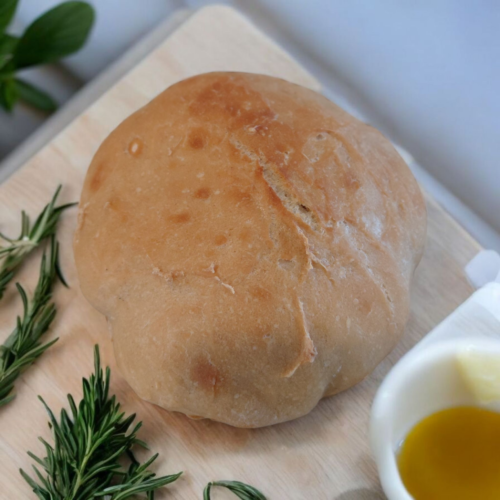
- Serve and Enjoy. Your loaf is ready! Slice through the golden crust and listen for that satisfying crackle. Serve warm and dip each slice into:
- Creamy butter for classic comfort
- Extra virgin olive oil and balsamic vinegar for an Italian touch, or
- Infused oils with fresh herbs for a gourmet finish.
- Pro Tip: Sprinkle a little sea salt or crushed rosemary over the oil for extra depth of flavor.
👩🍳 Chef Tips
- Fold in seeds, herbs, or olives after the first rise.
- Experiment with small percentages of whole wheat or spelt.
- Store at room temperature in a paper bag or freeze for longer shelf life.
My Baking Experience with Artisan No-Knead Bread
I’ve always loved the taste of high-quality artisan bread — that rustic crust, the soft open crumb, and the way each slice soaks up olive oil, Italian herbs, and a drizzle of balsamic vinegar. It’s simple, healthy, and deeply satisfying.
But there’s one part I never enjoyed: the heavy kneading. It felt like a little too much work for a quiet Sunday craving.
I was super excited when I discovered the magic of no-knead bread — a recipe so effortless. You just mix flour, water, yeast, and salt… and let time do the work. Hours later, the dough transforms on its own — airy, silky, and alive.
When baked in a hot Dutch oven, it emerges with a crackly golden crust and that unmistakable artisan aroma that fills the kitchen with joy. No machines, no kneading — just patience and a touch of wonder.
Because of Jim Lahey, the brilliant baker who shared this revolutionary technique with the world, anyone — even the most casual home cook — can now bake bread that tastes like it came straight from a rustic Italian bakery.
If you’ve ever dreamed of baking real artisan bread — beautiful, fragrant, and full of soul — this is your sign to try. The magic of no-knead bread isn’t just about baking. It’s about slowing down, trusting the process, and discovering how simple ingredients can become something extraordinary.