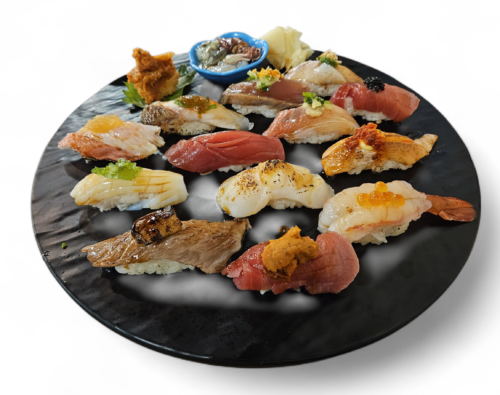
Sushi is an art that you can taste. It is precision, restraint, imagination, memory, geography, time, and craftsmanship — all compressed into a single perfect bite.
To understand why sushi captivates the world the way it does, you have to go back — far back — before omakase counters and Michelin stars. Sushi’s story begins not in Japan… but in the flowing rivers of Southeast Asia.
Sushi began in Southeast Asia as a method to preserve life. Japan turned it into a way to celebrate life. From the rivers of Southeast Asia to the omakase counters of Tokyo and New York, sushi has traveled across time, cultures, and generations — yet never lost its soul.
People who love sushi don’t simply crave flavor. They crave the experience. The next time you eat sushi, slow down. You are tasting art.
The Surprising Beginning: When Sushi Preserved Life
More than a thousand years ago, along the Mekong River in Southeast Asia, fishermen faced a problem: How do you keep fish edible for months without refrigeration?
Their solution: pack fish in salt and cooked rice, allowing it to ferment slowly. The rice was not meant to be eaten — it was simply a preservation tool. It wasn’t cuisine. It was survival.
Yet this ancient technique migrated — first to China, and eventually to Japan — where everything changed.
Japan: The Moment Preservation Became Art
When the fermentation method arrived in Japan, the Japanese didn’t just accept it. They reimagined it. First, they began eating the rice with the fish — a radical shift. Then, innovation took its boldest leap during the Edo period (1603–1868): Fresh fish + vinegared rice = the birth of modern sushi.
No more waiting months. No more fermentation. Sushi became immediate, fresh, and alive — the embodiment of the Japanese aesthetic: simplicity, precision, and respect for nature.
What started as necessity had now become culinary poetry.
The Itamae: A Sushi Chef as Artist and Craftsman
In Japan, the itamae — a true sushi master — does not cook food; they shape experience.
- Tools & knives: Each blade is specialized and cared for meticulously, ensuring precise cuts that honor the fish.
- Rituals: Washing rice, seasoning it, slicing fish — every movement is deliberate.
- Mindset: Focus, presence, and respect for ingredients elevate sushi from food to artistry.
Becoming an itamae requires 10+ years of apprenticeship, where mastery of fundamentals builds the foundation for creative expression.
- First year: washing rice… only rice
- Later: knives, filleting, temperature control
- Finally: shaping the perfect bite
A sushi chef’s training is not about speed — but presence. You are not just watching someone prepare food. You are watching someone perform decades of discipline in silence. That’s why a single piece of sushi served by a true master feels emotional — it carries the weight of time.
Omakase: When the Chef Reads the Soul, Not the Menu
Omakase is a Japanese dining experience where the guest entrusts the chef to select and serve a meal, essentially saying “I leave it up to you”.
The chef curates each piece based on season, catch, and your preferences.
- Every bite becomes a dialogue between chef and diner.
- Luxury emerges not from opulence, but from perfect execution, trust, and attentiveness.
Omakase is the epitome of sushi as high art, where mastery and experience converge on your plate.
The chef observes:
- the season
- the catch of the day
- the temperature of your hand when you pick up a piece
- your reaction to your first bite
Then — quietly — they adjust the next. An omakase meal is a dialogue without words.
Sushi Today: Where Tradition Fuels Creativity
Many cuisines bend under modernization. Sushi does the opposite — it blooms.
Around the world, chefs reinterpret the craft while honoring the spirit. Some focus on:
- micro-seasonality
- regional terroir in seafood
- fusion ingredients
- sustainable sourcing
- artistic plating and sensory storytelling
Yet the core remains untouchable: Rice + fish + respect. Innovation never replaces tradition — it rises because of tradition.
Why Sushi Captivates Us Even Before We Take a Bite
Sushi satisfies something deeper than hunger. It resonates because it awakens:
- our desire for simplicity in a complicated world
- our appreciation for skill and mastery
- our curiosity for beauty in the smallest details
- our admiration for people who dedicate their lives to craft
Each piece of sushi is a meditation — a reminder that perfection is not loud. Perfection is quiet, deliberate, and intentional. That is why sushi will never go out of style.
Top-tier Sushi Restaurants Around the World
- Sushi Saito – Tokyo, Japan – Revered for impossibly precise nigiri that melts like snow—considered the closest thing to sushi perfection.
- Sushi Yoshitake – Tokyo, Japan – Known for deep umami and ultra-refined aging techniques that turn simplicity into alchemy.
- Nihonbashi Kakigaracho Sugita – Tokyo, Japan – Famous for its warm hospitality and emotional dining flow, where each piece heightens the next.
- The Araki – London, UK – A rare Edomae counter outside Japan serving world-class toro and a theatrical, intimate omakase.
- Sushi Nakazawa – New York City, USA – A transformative journey in flavor progression—playful, emotional, and technically flawless.
- Sushi Noz – New York City, USA – A Kyoto-inspired cedar sanctuary delivering poetic, meditative sushi with almost spiritual purity.
- Ginza Sushi Ichi Singapore – Singapore – Directly flies fish from Tokyo’s Toyosu Market—synonymous with consistency and elite seafood sourcing.
- Sushi Sanshin – Osaka, Japan – Beloved for umami-forward aged fish and a surprisingly warm, human-centered dining style.
- Sushi Minazuki – Osaka, Japan – A rising star counter focusing on seasonality to the extreme—no two months ever taste the same.