Few dog breeds capture the world’s imagination quite like the Labradoodle — the irresistibly charming cross between a Labrador Retriever and a Poodle. Beyond its teddy-bear looks and playful personality lies a story of purpose, innovation, and accidental fame.
The Labradoodle is more than just a cute hybrid. It’s a living symbol of compassion and creativity — proof that when humans blend science with heart, something truly wonderful can emerge.
Born from a quest to serve, the Labradoodle evolved into one of the world’s most beloved companions, uniting the brains of the Poodle with the heart of the Labrador.
Whether guiding the blind, comforting patients, or simply being the family’s fluffy ball of love, Labradoodles remind us of life’s simplest truth: Joy multiplies when shared.
The Origins: A Quest for the Perfect Guide Dog
The Labradoodle’s story began in Australia in the late 1980s. Wally Conron, breeding manager at the Royal Guide Dog Association of Australia, faced an unusual challenge: a visually impaired woman in Hawaii needed a guide dog that wouldn’t trigger her husband’s severe allergies.
Traditional guide dogs like Labradors were out of the question because of their shedding coats. So Conron decided to experiment — he crossed a Standard Poodle (known for intelligence and a low-shedding coat) with a Labrador Retriever (famous for its trainability and kind temperament).
The result was Sultan, the first Labradoodle — a brilliant, gentle dog who not only passed guide dog training but also did not cause allergic reactions.
“I bred the Labradoodle for a blind lady whose husband was allergic to dogs — and the world went mad.” — Wally Conron
From Service Dog to Global Star
After Sultan’s success, Conron introduced the Labradoodle to the world in 1989. At first, people were skeptical — few understood what a “crossbreed” could offer. But when he coined the catchy name “Labradoodle,” the idea spread like wildfire.
By the early 2000s, Labradoodles had leapt from guide dog programs into homes around the world. Their friendly disposition, minimal shedding, and expressive, human-like eyes made them the ultimate family companion — beloved by children, admired on social media, and cherished in therapy work.
The Science Behind the Smile
Despite their fame, Labradoodles remain hybrids, not a standardized breed. This means that no two are ever quite the same:
- Some have tight curls like Poodles, while others sport loose, shaggy coats.
- Temperaments can range from calm and gentle to energetic and playful.
- Their “hypoallergenic” nature depends on genetics — not every Labradoodle is allergy-safe.
Over time, Australian breeders developed multigenerational lines (now called Australian Labradoodles) by adding breeds like the Cocker Spaniel to refine coat texture and stabilize temperament.
The Human Connection
At its heart, the Labradoodle story isn’t just about genetics — it’s about connection. It began with compassion: one person’s need and another’s creative response. That spirit of empathy continues in every Labradoodle’s joyful wag and loving gaze.
Their intelligence, warmth, and emotional intuition make them more than pets — they’re partners in life. Labradoodles sense human emotions with uncanny accuracy, often comforting their owners without a single word.
My Labradoodle
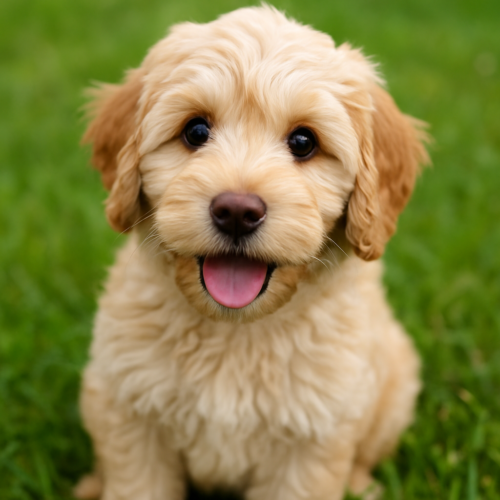
I’m lucky to have one of these wonderful companions — a fluffy, curly, endlessly affectionate Labradoodle named Cuddle.
Cuddle is soft like a cloud and full of pure, innocent joy. He loves long walks, chasing birds, and exploring every scent along the path. Sometimes, I let him try a little human food just to see his excitement at new flavors — a small way to make his world more colorful.
When I call, “Cuddle, Cuddle!” he rushes over instantly, tail wagging furiously, eyes sparkling with love. He leaps into my arms and covers me in playful licks, as if reminding me that happiness is simple — it lives in the moment.
When I throw a ball, he races after it with lightning speed, ears flopping and paws flying. Every game, every cuddle, every joyful bark makes life feel lighter and more alive. His very presence turns ordinary days into moments of warmth and laughter.
🐾 Fun Facts About Labradoodles
- The name “Labradoodle” inspired dozens of other “-doodle” breeds, including the Goldendoodle, Bernedoodle, and Aussiedoodle.
- Though often called “designer dogs,” their origin was entirely functional, born from a desire to help.
- Labradoodles are exceptionally emotionally intuitive — many owners say their doodle can “read” their moods better than people.
- Their coats come in stunning colors: cream, apricot, chocolate, black, caramel, and even phantom patterns.
🐶 Bring Home A Labradoodle Smile
For discerning lovers of the Australian Labradoodle, like my own cherished companion, Southern Meadows in Alabama USA offers an accredited, trusted, family-run in-home breeding experience. Each puppy is lovingly raised with exceptional care, ensuring a harmonious temperament, delightful character, and the highest standards of breed excellence.