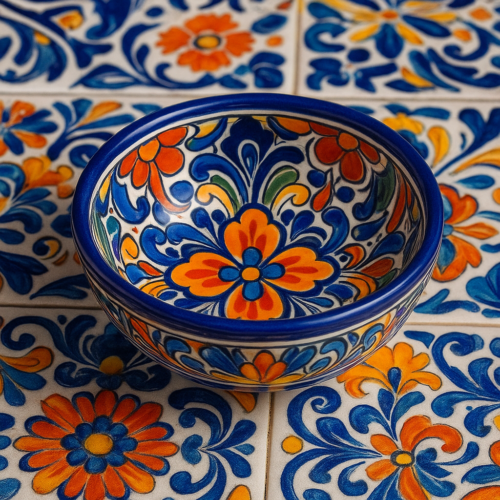
In the sun-warmed city of Puebla, Mexico, a centuries-old craft continues to whisper stories of patience, artistry, and cultural fusion — Talavera pottery. More than ceramics, Talavera is living history — a symphony of clay, color, and devotion passed from one generation of artisans to the next.
Every piece tells a story — of worlds that met, traditions that blended, and beauty that endures through the steady hands of those who still believe that time and craft can coexist in harmony.
The Origins: When Worlds Met in Clay
The story of Talavera begins in the 16th century, when Spanish settlers arrived in Mexico, bringing with them the ceramic techniques of Talavera de la Reina, a Spanish town known for its glazed pottery.
These techniques, deeply influenced by Moorish artistry — with its geometric patterns, symmetry, and vibrant cobalt blue — found new life in the fertile valleys of Puebla.
Here, Mexican artisans fused European craftsmanship with indigenous creativity, adding local symbolism, native pigments, and a distinctly Mexican warmth. What emerged was not imitation — but transformation: a new, soulful art form known as Talavera poblana.
Talavera became a dialogue between continents — Spain’s structured precision meeting Mexico’s expressive spirit. Each piece embodied cultural fusion long before globalization existed.
The Sacred Ritual of Craftsmanship
Authentic Talavera is still made almost exactly as it was centuries ago. Every step is deliberate, intimate, and unhurried.
- Clay is gathered from the earth around Puebla — a volcanic blend unique to the region.
- It is shaped by hand, dried under the sun, and fired twice in a kiln to achieve its distinctive density and sheen.
- Once hardened, artisans apply a tin-based glaze and hand-paint each design using natural mineral pigments — often cobalt blue, yellow, black, green, and mauve.
There are no shortcuts. No two pieces are identical. Each bears the marks of its maker — the human touch that modern machines can never replicate.
To hold a Talavera plate is to hold patience made visible — hours of labor condensed into beauty, imperfection transformed into art.
The Language of Patterns and Color
The motifs of Talavera are not random decorations; they are symbols, passed through generations like a silent alphabet of faith, nature, and balance.
- Blue and white — purity, truth, and the influence of Islamic ceramics.
- Floral designs — the vibrancy of life, fertility, and connection to the natural world.
- Geometric symmetry — order within chaos, balance between the divine and the earthly.
- Animal and vine motifs — harmony between humankind and nature.
Each brushstroke carries meaning. Each color is a message. Together, they form a universal truth: beauty endures where the human hand and heart are aligned.
The Cultural Symbol of Puebla
By the 17th century, Talavera had become one of Mexico’s most prized crafts. Puebla’s churches, convents, and homes were adorned with radiant tiles — facades shimmering under sunlight, interiors blooming with intricate murals.
The craft was so revered that it was legally regulated. Only certified workshops could produce “true Talavera,” ensuring that quality, authenticity, and tradition were preserved. To this day, only a handful of artisan families hold this certification — their workshops recognized by Mexico’s government as guardians of national heritage.
Each artisan carries not just skill, but legacy — continuing a dialogue that began over four centuries ago.
Talavera in Modern Times: Tradition Meets Design
While rooted in history, Talavera continues to evolve. Today, it graces luxury interiors, architectural masterpieces, and global art collections. Designers incorporate Talavera tiles into modern spaces, blending tradition with contemporary elegance — a reminder that heritage, when cherished, never fades.
In a world obsessed with efficiency and uniformity, Talavera stands as a quiet rebellion — a return to authenticity, artistry, and slowness.
It asks us to remember: “The most beautiful things are those made by human hands, with care, time, and soul.”
A Lesson from Talavera: Art as a Way of Living
Beyond its colors and clay, Talavera carries a quiet wisdom for modern life: Slow down. Create with intention. Honor tradition — yet leave your own touch.
Each Talavera tile bears the imprint of its maker — a reminder that our lives, too, reflect the care, patience, and devotion we bring to them. When we live like Talavera artisans — deliberate, focused, and fully present — even the simplest acts become art.
Talavera is more than an object of beauty. It is a living testament to human creativity, a bridge between past and present, art and identity, imperfection and mastery.
To collect a piece of Talavera is to hold history in your hands. Art is not what we make — it is how we live.
Interested in Talavera?
Discover the Handcrafted Talavera Mini Bowl at Solvrée Shop — a vibrant expression of Mexican artistry, where culture, color, and craftsmanship come to life. Each piece is uniquely painted by skilled artisans, blending timeless tradition with contemporary charm. Perfect as a decorative accent or thoughtful gift for those who appreciate art, culture, and refined living.
Next time you visit Puebla Mexico, immerse yourself in the world of Talavera at Uriarte Talavera — one of the oldest and most prestigious Talavera producers, founded in 1824 and officially recognized by the Mexican government for its authenticity. A cornerstone in preserving traditional Talavera techniques that date back over 500 years, Uriarte Talavera allows visitors to tour the showroom, witness the full process from lump of clay to intricate hand-painted design, and acquire exquisite, handcrafted pieces.