Salt has quietly shaped bread culture for centuries, but salt bread as we know it today — buttery, spiral-rolled, and crowned with sparkling salt — is a story of reinvention, migration, and revival.
Europe: The Foundational Era of Salt-Seasoned Breads
Long before modern salted butter rolls appeared, Europe pioneered salt-forward baking. In medieval villages and monasteries, salt was precious — a seasoning, a preservative, and a structural aid that strengthened gluten and prolonged shelf life.
- Germany & Austria: Monastic bakers shaped early pretzels dusted with rock salt.
- France: Country bakers crafted rustic pain de sel-style rolls crowned with coarse crystals.
These breads were honest, sturdy, and essential — born from scarcity, perfected by craft.
Baltic & Slavic Traditions
In Eastern Europe, bread and salt became a sacred pairing. Families welcomed important guests with Khleb da sol — symbolizing abundance and protection. Even today, heads of state in countries like Poland and Russia are sometimes greeted with this ritual.
Japan: Reinvention & the Birth of Shio Pan (Post-1945)
After 1945, Japan entered a culinary renaissance. Western baking methods arrived, but Japanese bakers reshaped the philosophy — favoring softness, aroma, shine, and individual portions.
- Instead of mixing butter into dough, they rolled chilled butter inside, creating a signature tunnel of richness.
- Milk replaced water for tenderness, and flaky salt finished the crust for sparkle and contrast.
Thus, Shio Pan was born — lighter, softer, and more sensory than its European ancestors. It quickly became a bakery staple, enjoyed alongside coffee in tranquil moments between ambition and rest.
South Korea: The Viral Era of Sogeum-ppang (2019–2023)
South Korea embraced Shio Pan and amplified it into Sogeum-ppang — butter-heavier, visually dramatic, and irresistibly photogenic.
- Korean bakeries pushed the butter filling further, often finished with sugar, cheese, or honey-butter glazes.
- Social media chronicled molten butter leaking into pans and golden buns glistening under salt flakes, sparking viral fascination and global curiosity.
Salt bread evolved from a bakery classic into global virality.
The Modern Spread: The Americas & Europe (Again)
Salt bread reached the Americas and beyond largely through:
- Japanese and Korean bakery artisans abroad
- Specialty Asian markets
- Social media-driven home baking movements
- Modern European revival of salt-butter rolls in the 2020s
Europe, the birthplace of salted bread techniques, ironically re-adopted salt-butter rolls in the 2020s, completing a delicious full-circle moment of revival.
Cultural Traditions Around Salt Bread
Salt bread has always symbolized connection, nourishment, welcome, and simple luxury.
Region | Tradition |
Eastern Europe | Bread and salt served to honor guests and newlyweds |
Jewish households | Challah with salt for blessings |
Northern Italy | Pane Toscano without salt (historical salt taxes) — salt served beside bread |
Japan | Shio Pan symbolizing simple joy and daily comfort |
Middle East | Sharing salty flatbread during Ramadan and gatherings |
Why People Love Salt Bread
Salt bread carries a consistent emotional message:
- Simple but extraordinary — minimal ingredients done exceptionally well
- Everyday comfort with artisan soul
- Sensory delight — aroma, shine, texture
- Magic of butter + salt contrast — luxury without complexity
Bread doesn’t need more to be enjoyable. Sometimes, all it needs is butter, salt, and time.
My Experience with Salt Bread
I’m a minimalist at heart, someone who finds joy in simplicity, especially when it’s done exceptionally well. That’s why salt bread and croissants have always been my favorites, because they are humble, soft, and made with only the simplest ingredients, where quality speaks louder than excess. There is a quiet kind of satisfaction that only high-quality simplicity can offer — clean, gentle, and deeply fulfilling.
I try to make my own bread using the no-knead technique, because I care deeply about the ingredients. Choosing them mindfully becomes a small act of self-trust, a quiet reminder that you are what you eat. I reach for high-quality flour, grass-fed butter, and pure sea salt — simple ingredients, but rich in honesty. When I know exactly what goes into what I eat, something settles softly inside me. I feel nourished, healthy, grounded.
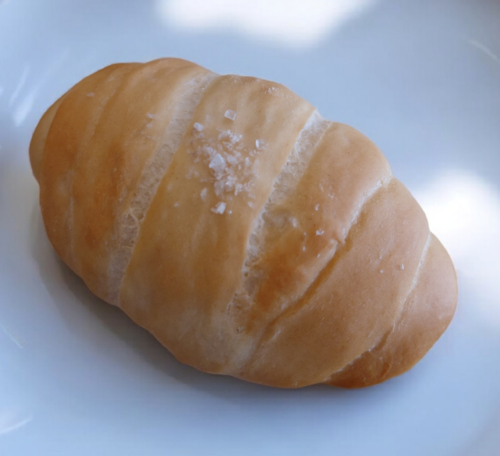
What I love most about salt bread is its simple and soft. The cloud-like softness when you tear it apart, the whisper of butter in the air, the delicate crunch of flaky sea salt resting on top like morning frost. The aroma is warm and comforting, buttery yet light, simple yet rich. Each bite feels homemade, pure, wholesome, and quietly luxurious.
Imagine pulling a freshly baked salt bun apart, the steam rising softly, carrying hints of butter and wheat. A touch of sea salt sparkles at the edges. The crust gives way with a gentle crackle. The inside is impossibly soft, warm, and fragrant. You take a bite, and everything feels calm, clean, and complete.
👩🍳 Chef-Inspired Recipe: No-Knead Salt Bread
🍞 Ingredients (10–12 rolls)
Night Before:
- Bread flour — 400 g
- Milk — 220 g
- Sugar — 30 g
- Instant yeast — 3 g
- Salt — 7 g
Mix until slightly sticky (no butter yet). Cover and refrigerate overnight. No kneading required.
Next Day — Shape:
- Divide dough into 10 pieces; form light balls. Rest 10 minutes.
- Roll each into a long oval triangle.
- Place a tiny cold stick of butter at the wide end (I like putting just a little, but high-quality butter. It melts softly into the dough, leaving a light buttery aroma, not overwhelm).
- Roll tightly toward the point to form a crescent log shape. Seal ends well.
Proof & Bake:
- Proof 45–60 min until slightly puffy.
- Brush tops with melted butter; sprinkle flaky salt.
- Bake at 210°C / 410°F for 12–14 min.
- Optional: For ultra-crispy exterior, bake last 2 min with oven door cracked open.
After Baking:
- Brush again with melted butter if desired.
- Rest 5 min before eating.
✔ Butter inside creates a hollow buttery tunnel with soft, chewy texture.
Baking Tips
- Salt: Use flaky (Maldon) or coarse sea salt; avoid table salt.
- Sprinkle technique: 6–8 flakes per roll from ~30 cm height for natural distribution.
- Butter leakage: Freeze butter sticks, roll tightly, seal ends, avoid over-proofing, bake at proper heat.
Flavor Variations
Style | Variation |
Sweet | Dust with sugar after baking |
Savory garlic | Brush with garlic butter |
Seaweed butter | Add aonori inside with butter |
Truffle | Brush with truffle butter + fleur de sel |
Spicy Korean | Add gochujang butter |
Common Causes of Butter Leakage & Fixes
Cause | Fix |
Butter too soft | Freeze sticks before shaping |
Dough not sealed | Pinch seams and ends firmly |
Rolling too loose | Roll tightly, maintain tension |
Over-proofing | Proof until slightly puffy; finger dent test |
Oven too hot initially | Start at high heat 200–210°C, adjust after 5 min |